
Tangier Kasbah
The fortified quarter with the Kasbah Museum
The Kasbah is the fortress above Tangier's medina, and its square has been protected since 1947. The former palace, Dar al-Makhzen, houses the Kasbah Museum of Mediterranean Cultures, and a few metres away the old Kasbah prison has become a space for contemporary art.
On this page
The fortified quarter
The Kasbah is the fortress that dominates Tangier's medina. Its square, the Place de la Kasbah, and the area around it have been protected since 1947. The south wall of the Kasbah has two gates, Bab Haha and Bab L'Assa.
For centuries the Kasbah was the seat of power. On the site of today's museum, the Portuguese governors resided in the Domos Praefecti between 1471 and 1661, and from 1662 to 1684 the English governors lived in a larger castle, the Upper Castle. The palace built after 1684 has been the seat of power and the symbol of local authority ever since.
The Kasbah Museum
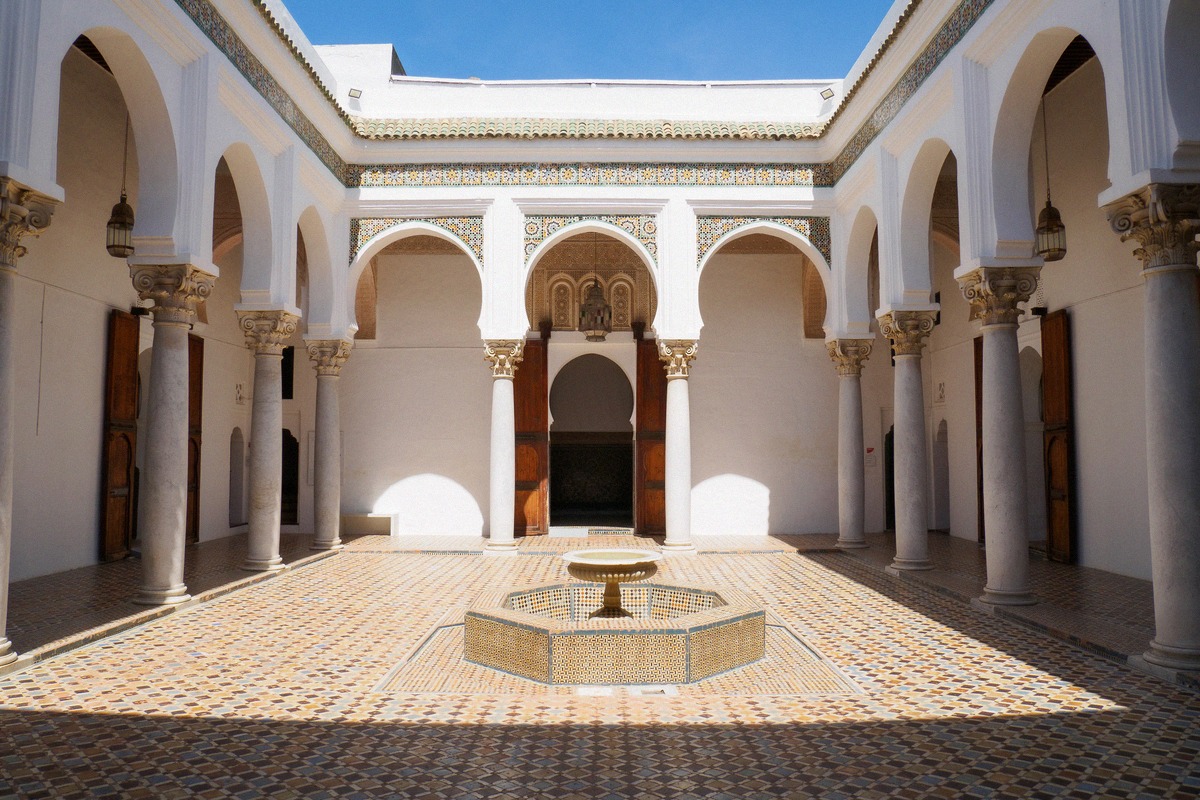
The Kasbah Museum of Mediterranean Cultures occupies the eastern part of the Kasbah, in the former palace known as Dar al-Makhzen or the Sultan's Palace. The palace was the work of Ahmed Ben Ali, son of Caïd Ali Ben Abdellah El Hamani Errifi, who drove the English out of Tangier in 1684. A founding inscription in the zellige tilework of the Qobbat Dar el Boukhari gives the year 1151 of the Hegira, which is 1737-1738. Under the sultans Moulay Slimane and Moulay Hassan I the building was altered several times.
The palace follows the pattern of a Moroccan seigneurial residence, with an open courtyard, a large garden and a clear line between private and public rooms. The decoration is Moroccan, with zellige, carved plaster and domes of painted or carved wood, while the curved columns and composite capitals of white marble in the great patio are European.
The archaeological and ethnographic collections are shown in three sections that follow the layout of the palace. A chronological route with thematic stops traces the history of Tangier and its links with the Mediterranean world.
The Espace d'art contemporain
A few metres from the museum, the former Kasbah prison now houses the Espace d'art contemporain. The prison was built in the 17th century as part of Dar El Mekhzen, the administrative and political core of old Tangier, and remained in use until the 1970s. Today it hosts temporary exhibitions and a cultural programme, mostly linked to the north of Morocco.
Visiting the Kasbah
Both museums open from 10:00 to 18:00 and are closed on Tuesdays. Reduced tickets apply to visitors aged 12-18 and to children under 12, and the prices are listed under Visiting the Kasbah Museum below. Because the Kasbah rises above the medina, a visit fits well with the lanes of the old town, the American Legation and Dar Niaba, all described on the medina page. Other sights in Tangier are on the things to do page.